- The ability to arrest time (here still photos have the advantage over movies),
- The ability to condense time onto a single image (so that multiple lightning strikes become overlayed into a single megaburst in the print)
Here's an example that I shot from our of my window a couple of years ago. Feel free to click through to my flickr page to see it large (it looks way better that size anyway.)
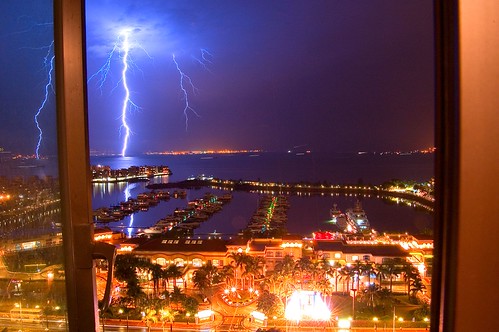
Bearing this in mind, lets have a quick look at how to set up and shoot lightning without becoming a statistic. Just remember that lightning is VERY dangerous, and the rain that usually accompanies lightning does no good to you camera. For this reason I tend to do my lightning shoots indoors, usually from my apartment window. I don't like to go wandering round hillsides and fields, just asking for a quick zap as I hold onto the steel of my tripod and put it into puddles of water.
In terms of camera settings, you need to use manual settings on you camera for this, and you definitely need to use a long exposure. It's hard to guess the exact moment when lightning will strike, so what I usually do is set my camera on bulb or between 20 and 30 second exposure times (tripod essential), and shoot while hoping that the strike will hit during that time. This can be frustrating, and requires patience, but here again the advantage of being safely indoors makes itself clear. Rather than freezing in the rain on some blasted heath, I prefer to be warm, dry and having a coffee or a whiskey. You will find that lightning tends to strike between frames, no matter how short you keep your time between button presses.
For the F-stops, the key is to maximize your depth of field: it sucks to get a perfectly exposed, perfectly timed shot of lightning that has a great foreground and blurry lightning. So, minimize the bokeh, and shoot between f16 and whatever the minimum on your lens is.
I also usually shoot my lightning at night: I'm at home more (the day job does tend to get in the way of these kinds of experiments) and I can also be more sure that a long exposure won't overexpose my shot. I still go for quite a low ISO rating, especially on my older Nikon D50, which tends to be very noisy.
Compositionally, I try to put some other things in the frame. A photo of black sky and a streak of lightning doesn't look great, but a shot of a hillside or a house or some other feature gives balance, interest and scale to the shot.
And that's how I shoot lightning. Feel free to check out the incredible lightning shots in the Flickr Top Twenty Lighning Shots pool, or look at National Geographic for more great photos. And you can always read the National Geographic Field guide to Landscape Photography for more on how to shoot this incredible natural phenomenon.